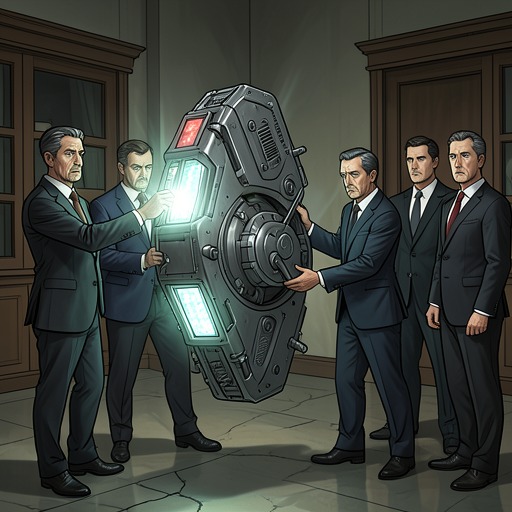
Earth space-weapons prohibition
Gate CrashersThe Earth space-weapons prohibition is the long-standing ban on stationing offensive weapons in space, and its decisive importance emerges when Earth faces a punitive expedition capable of destroying the planet. By preserving space as a demilitarized domain, the prohibition prevents ordinary military deterrence; when the crisis comes, humanity possesses exploration vessels, civilian infrastructure, and an asteroid-defense system, but no ready means of fighting back.
Origins and Legal Scope
The prohibition grows out of the Outer Space Treaty, which formally banned nuclear weapons in space and the construction of military bases beyond Earth. In practice, however, an international gentlemen’s agreement broadened that narrow treaty language to cover offensive weapons generally. The result was not merely a technical restriction on particular devices but a durable political norm: space remained free of weapons from the earliest period of spaceflight, and Earth organized its security assumptions around that condition.
The rule’s stability also made it politically consequential. The discovery of the alien buoy and the warning that Earth was being treated as a wildlife preserve transformed the old settlement from background law into an urgent strategic question. Gladstone Rockwell, whose real constituency was Lockheed-Boeing-Raytheon, saw the extraterrestrial frontier as the defense industry’s final frontier. The possibility that humanity had found a boundary separating it from the wider galaxy suggested contracts worth untold trillions and raised fears of an arms race comparable to the Cold War.
The Prohibition Under Pressure
The rule shapes the first human response to the revelation of extraterrestrial contact. Danielle Fenton explains that the cabinet wants a deterrent in case first contact turns hostile, while Eugene Graham objects to describing the aliens as an enemy to be confronted. The proposed expedition therefore combines diplomacy with a show of strength rather than relying on an established space arsenal. That compromise exposes the prohibition’s paradox: humanity wants to appear capable of defending itself, but the legal order has prevented it from possessing the weapons that would make such a display credible.
The prohibition also sharpens the contrast between human restraint and the violence practiced elsewhere. The Lividites once used a high-space portal to bore a tunnel through a planet, collapsing it into an apocalypse; the destruction of Culpus-Alam becomes the central geocide for which Earth is falsely blamed. The Turemok Pacification Force likewise approaches human vessels with an armed ultimatum, and the larger political system considers punitive action before responsibility has been conclusively established. Against these examples, Earth’s ban appears morally principled, yet the surrounding civilizations interpret vulnerability through military logic rather than legal sympathy.
Crisis and Strategic Vulnerability
The prohibition becomes most concrete when Earth learns that a punitive armada has already been dispatched. Even after evidence emerges that humans did not destroy Culpus-Alam or the other accused worlds, the Assembly cannot halt the expedition because it was sent weeks earlier, following the reported destruction of Kulla. The legal process therefore operates beside an irreversible military decision: investigation may correct the record, but it cannot immediately recall the force already in motion.
Earth’s lack of weapons leaves Jacqueline Dorsett and Felix Fletcher with almost nothing to deploy against the approaching threat. Bucephalus is the only human warship, and it is away from Earth. The Asteroid Deflection Grid is the sole system that resembles a weapon, but its lasers require a decade of warning merely to divert a rock. The distinction between planetary defense and warfare becomes brutally clear: a system designed to manage foreseeable celestial hazards cannot answer an imminent military attack.
The consequences extend beyond the surface. Felix predicts that the attack will wipe Earth clean, destroy infrastructure, scatter debris through low Earth orbit, eliminate habitats and mining operations, and tear loose the space-elevator stations at geosynchronous orbit. The prohibition has therefore protected a principle at the scale of centuries, but in the emergency it leaves thirty billion people exposed, with no proportionate defensive capacity and no meaningful time to improvise one.
Political and Narrative Significance
The Earth space-weapons prohibition is not presented simply as foolish or wise. It is a test of whether legal restraint can survive a security environment in which other powers do not share the same restraint. The rule prevents an arms race before contact, but the absence of weapons also encourages adversaries to treat Earth as harmless, while human leaders begin to imagine deterrence as necessary the moment the galaxy’s power structure becomes visible.
Its deepest irony lies in the mismatch between intention and consequence. Earth’s governments have avoided placing offensive weapons in space for centuries, yet the first major interstellar crisis turns that restraint into an inability to protect civilians, orbiting habitats, or even the planet itself. The prohibition thus converts the ethical achievement of demilitarization into a strategic liability—not because the principle is disproved, but because justice and survival are forced into conflict before any shared authority can enforce either one.